

All of our content is free to read. Consider upgrading to become a Friend of the Trust and help support our work. Paid subscribers will also be able to join the conversation through comments.
Written by Liz Gregory, GLST Manager
A new Victorian report into Inquiry into the recruitment methods and impacts of cults and organised fringe groups has said,
“Harm arises not from theology or ideology itself, but from patterns of coercion, control and exploitation that strip individuals of their autonomy and capacity for free decision-making.”
I couldn’t have summed it up more precisely than that.
This issue is “having a moment” across the world at present. There is a huge increase in the research that is occurring in this space, and survivors are feeling emboldened to speak of their experiences. New Zealand is right in the middle of this call for better understanding and solutions to deal with coercively controlling groups, with international eyes firmly on the Gloriavale situation.
The Victorian Inquiry is going to be one of the most powerful tools in advocate’s tool belts moving forwards. There is a group of cult-informed professionals in New Zealand who have been calling for law reform in the NZ space too - so we are watching Australia closely. NZ doesn’t need to conduct its own inquiry. It just needs to accept that their report is applicable in our context and follow closely behind Victoria’s lead.
While the Gloriavale Leavers’ Support Trust did not contribute to the inquiry, we were referenced several times during the Victorian Inquiry as an example of the kind of specialist support that survivors need.
Major Headlines
During 2025/2026 a significant investigation was conducted into cults and coercive groups in Victoria Australia. Submissions were received from survivors and experts and the report, along with recommendations, was recently tabled. It was not surprising to read the the similarity of experiences from people leaving culty groups in Australia, with the those shared by Gloriavale leavers. It just reaffirms that cultic harm occurs across boundaries, regardless of the belief system they are wrapped up in.
Cults can be religious, but they might be political in nature, or a wellbeing, or business cult. What we do know is they create a particular and unique kind of harm that our social services are ill-equipped to recognise and understand. This report did well to remove the issue from the religious freedom arguments and focus on the coercive behaviours that occur. They titled the final report, “Coercion and harm in high‑control groups.” The report did well to explain that while the word cult has an important role to play, the word coercion is a better option as the basis for legislative reform.
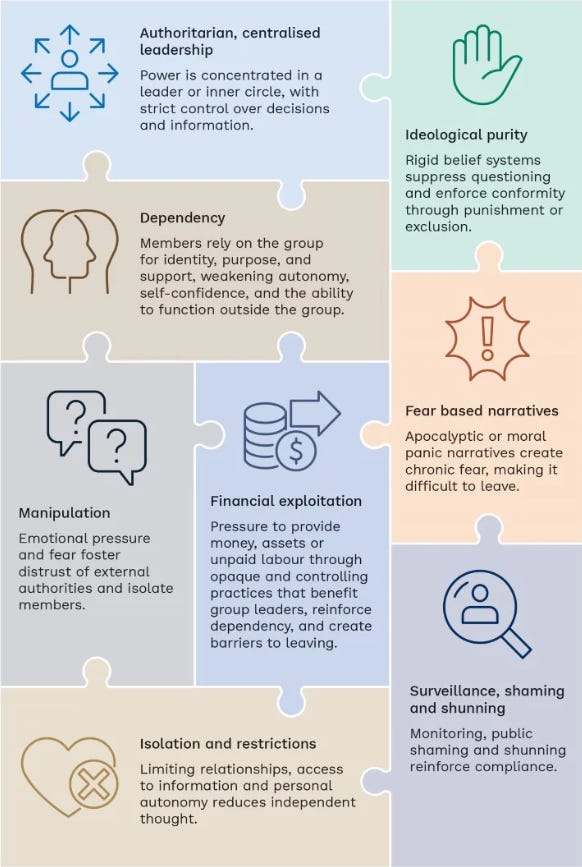
Cults ultimately include a totalitarian or authoritarian leadership structure, a programme of indoctrination, which requires you to fuse with the group and lose your identity in the process, a systematic process of isolating you from wider society, and an environment of control and dependency that reaches into almost every area of a person’s life. This report brilliantly identified the mechanisms at play.
Inside these self-sealing systems the concept of “choice” becomes increasingly illusory, while obedience and unity become front and centre. The question becomes much simpler and much more important: are people genuinely free, or has the system around them progressively taken that freedom away?
Sadly inside these groups the evidence reveals that extremely high rates of abuse and exploitation occur. It’s usually a clear recipe for disaster, as we have seen in the Gloriavale situation.
This report spent a lot of time documenting the harm, by using survivors own experiences, but they went a step further to uncover the mechanics of recruitment and psychological coercion.
Figure 2.2 Common characteristics and harmful dynamics of coercive high control groups p. 31.
Impacts of Cultic Harm
The impacts of cultic and coercive harm can reach into virtually every part of a person’s life. The Victorian Inquiry heard evidence of profound psychological and emotional harm, including fear, anxiety, shame, trauma, loss of confidence, impaired critical thinking and difficulty trusting one’s own judgement after years of indoctrination and control. People described disrupted education and employment, financial exploitation and poverty, unpaid or underpaid labour, restricted opportunities, family estrangement, shunning and the loss of entire social networks. Physical and sexual abuse, child abuse and neglect, sleep deprivation and barriers to appropriate healthcare were also reported.
For those born or raised within high-control groups, the effects can be particularly deep: normal development, identity formation, relationships and independence may all occur within an environment where obedience is prioritised over autonomy. Women and children were identified as especially vulnerable in some settings, with women reporting restrictions on education, employment, relationships and reproductive or personal choices. Leaving does not necessarily end the harm; former members can emerge without money, qualifications, housing, social networks or familiarity with ordinary systems, while simultaneously grieving family, community, faith and identity.
The Inquiry therefore presents cultic harm not simply as a collection of isolated abusive incidents, but as the cumulative consequence of coercive control that can affect a person’s psychological wellbeing, relationships, physical safety, education, finances, employment, spirituality and capacity to live independently long after they leave.
Gaps in Service Provision
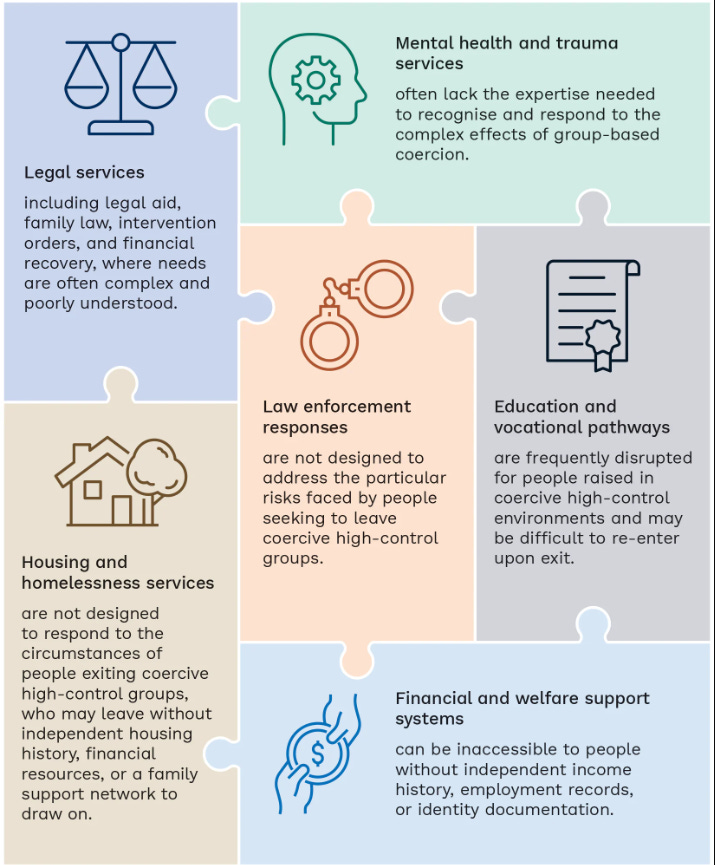
The Victorian Inquiry identified a major weakness in current service provision: agencies often see the individual problems, but miss the coercive system connecting them. A person leaving a high-control group may present with trauma, housing insecurity, financial hardship, disrupted education, family estrangement or employment issues, yet each service may respond only to the problem within its own remit. What can be missed is the underlying pattern of dependency, isolation, control and loss of autonomy that has produced those difficulties in the first place.
The report therefore calls for better professional training, stronger coordination between agencies, clearer referral pathways and more cult-informed support. For us, this is one of its most important conclusions: existing services may be excellent in their own fields, but still lack the specialist understanding needed to recognise cult-related harm and support people through the long process of rebuilding life after leaving.
Figure 5.1 Gaps across service areas p. 271.
Can the GLST support the Victorian Inquiry?
In evidence to the Inquiry, the Olive Leaf Network Australia, described the GLST as a “refugee-style service” - not simply therapy, but practical help to enable people to come out and rebuild their lives. They added that survivors hearing about the model had said they wished something similar had existed for them.
Anke Richter, journalist and Decult founder, told the Committee that the difference for recent Gloriavale leavers was “really noticeable” because they were met by people who understood what they needed and could help them transition into life outside.
Dr Janja Lalich similarly described the “Gloriavale Leavers Support Trust as having been “extremely successful in helping people leave” and encouraged Victoria to look at models like it when designing survivor support.
If the recommendations for improved services are implemented, we would be privileged to assist the Australian’s to develop their models to ensure leavers’ unique needs are being met.
We have so much more we would like to implement here in NZ for Gloriavale leavers, but we are restrained by funding and practical challenges. We are not short on ideas!
Recommendations
Then, to top it off, the report made 98 Findings and 39 Recommendations to Parliament. It was unbelievable and incredible to read! Read them all here. Or a shorter summary of the recommendations here. Or keep reading for the Top Ten.
It was pretty much a shopping list of everything the GLST and Gloriavale Leavers have been saying to Parliamentary representatives over successive years. There were recommendations for increased support services for leavers, increased training for professionals interfacing with cult survivors, greater public education and awareness about coercive and high-control groups, better coordination between government agencies, stronger safeguards for children and vulnerable people, improved financial and charitable accountability, a greater recognition of the importance of lived experience in shaping policy and services, and most importantly a new legislative framework to criminalise group coercive control.
The Top 10 recommendations (paraphrased)
The ten I would highlight for you are:
Establish a lived-experience advisory group so survivors of coercive high-control groups have an ongoing role in shaping government policy, services, education and reform.
Develop a clear, behaviour-based framework for coercive high-control groups, centred on patterns of coercion and harm rather than on beliefs, religion or ideology.
Ask the Victorian Law Reform Commission to examine a specific offence of group-based coercion, recognising that sustained patterns of domination may cause severe harm even where individual acts viewed in isolation are not criminal.
Ensure any legal reform contains safeguards for legitimate freedom of religion, association and belief, so that the law targets coercive conduct and serious harm rather than unpopular, conservative or unconventional beliefs.
Improve specialist support for people leaving high-control groups, including trauma-informed psychological care and practical assistance with rebuilding life after exit.
Train frontline professionals - including health practitioners, counsellors, police, lawyers, educators and social-service workers - to recognise coercive high-control dynamics and respond appropriately.
Improve coordination and information-sharing between agencies, so that government services do not each see only one fragment of the harm while missing the coercive system connecting those harms together.
Strengthen protections for children and young people, particularly those born into high-control groups who have no meaningful choice about participation and may have little contact with protective adults outside the group.
Improve public education and prevention, including helping young people and university students recognise coercive recruitment, manipulation, unhealthy dependency and other warning signs.
Strengthen regulatory oversight, including examination of gaps involving charities, workplaces, financial exploitation, modern slavery, education and other areas where coercive organisations can fall between existing regulatory systems.
The Committee’s overall direction was a behaviour-based legal and policy response, better services and identification, stronger coordination, and continuing research and monitoring.
A Call for Law Reform
The most important recommendation was to examine legislative reform around group-based coercive control, and to develop a much clearer, behaviour-based framework for identifying harmful groups - rather than getting bogged down in arguments about their beliefs or religious freedom. This final push towards bespoke legislation is the most significant development so far. Other countries have criminalised coercive control in the context of domestic violence - but there has never been any attention paid to group-based coercive harm. Until now.
(I recall in the early years asking Police why they couldn’t act more definitively in the Gloriavale space. They literally said they couldn’t find a law that suited the situation. Other countries make use of slavery and trafficking legislation, or workplace laws, but they mainly end up relying on the criminal justice system for individual physical and sexual abuse prosecutions.)
It’s clear until now there has been no pathway to bring accountability for those creating environments where intense psychological abuse and coercion are used to entrap people.
Will new laws end up targeting conservative Christian Churches?
Some churches and faith-based organisations in Australia expressed concern that new laws addressing coercive control could overreach and unintentionally capture religious groups simply because they hold conservative moral or theological positions on contested social issues. The report noted that these concerns should be heard and carefully considered. We are pleased to hear that this distinction has been made.
But that makes it even more important for faith-based organisations, and thinktank/lobby groups, to understand the difference between sincerely held belief and coercive control. No Christian should be comfortable with a church culture that demands blind obedience to authority, concentrates power in an unaccountable leadership, creates dependency, makes it extraordinarily hard to leave, punishes questioning or dissent, or allows abuse and exploitation to flourish. If this explains your church group’s behaviour, then it might be worth considering Christ’s own leadership example.
Good law reform should protect freedom of religion and belief while also recognising that religious freedom is not a licence for coercion, domination or abuse. We hope churches and other faith-based organisations will participate constructively in that discussion and help ensure any reforms are both carefully framed and effective in protecting people from harm. We intend to participate in those important discussions.
Closing Statement
For those of us who work alongside people leaving Gloriavale, much of the report feels remarkably familiar. Its recommendations for specialist support, professional education, survivor involvement, improved government coordination, stronger safeguards for children, greater accountability and a behaviour-based understanding of coercive control describe many of the same gaps we have been raising with government for years. We feel that this report may be useful to give our NZ Government the push it needs to make some changes. If you are an MP and would like to participate in moving this issue forwards, please make contact with us so we can connect you to the movers and shakers in this space.
A Call for Gloriavale to Reform
Standing on the platform of calling Gloriavale to reform (read blog post #2), we invite the leadership and members of Gloriavale to read the Victorian Inquiry Executive Summary, and identify the issues that have been outlined and apply them to yourselves as a learning opportunity.
Ask whether authority within Gloriavale is sufficiently accountable. Ask whether people are genuinely free to question leaders, disagree, make independent decisions, maintain relationships outside the Community, pursue education and employment of their choosing, control their own money, and leave without fear of losing family, housing, livelihood or belonging. All without consequence.
Examine the report’s discussion of dependency, isolation, indoctrination, shunning, barriers to exit, financial and labour exploitation, restricted autonomy, harm to children, gender inequality, and the conditions in which abuse can flourish. Then ask honestly: where do these patterns exist at Gloriavale, how did they come to pass, and what would genuine reform require?
Reform is not demonstrated by saying that things are different now. It is demonstrated by changing the structures, practices and power arrangements that allowed harm to occur in the first place.
What’s next in this space?
These recommendations will be examined in detail, and the Victorian Parliament has six months to respond. Will they be brave and implement the 39 recommendations? Is it possible to believe that there might soon be a law to bring some of this harm to an end?
The report is well worth the read if you’re interested in understanding the world of coercive dynamics.
Where can I be more fully informed about this report?
You can read the full report here. Volume One and Volume Two.
You can read the Executive Summary of the report here (50+ pages). Highly recommended.
Read a summary of the report that AI helped GLST Manager Liz Gregory compiled here. It includes the important features of the report, including quotes and a summary list of the recommendations.
Read an excellent summary of the collaborative submission “Beyond Belief” co-authored by survivors here.
Read the full list of 98 Findings and 39 Recommendations here. And a shorter summary here.
Read an ABC newspaper article about the report here.
Listen up to a Cult Chat episode (coming soon) where Liz Gregory (manager of the GLST) and Caroline Ansley interview Ryan Carey about his involvement in initiating the report. Find out how it gained traction and what he hopes to achieve.
References
Note: You can choose to read the Daily Vale articles from the GLST website, or from Substack.